CrazyGLCrazyGLHomeExploreGitHubBrowse heroesLoading hero…← Back to gallery@crazygl/database-core

Database Core

A central 3D database core — a stack of slowly rotating cylindrical disks with glowing seams. Query pulses radiate across the floor and flash through the core's seams; configurable satellite shapes orbit around it. Built for data platforms, ORMs, and infrastructure landing pages.

ReactWebGL3DInteractiveFont#3d#three#database#data-platform#infrastructure#developer#saas#pulse#pbr#premium

Usage

import DatabaseCore from '@crazygl/hero-database-core';

export default function Page() {
  return (
    <DatabaseCore
      heading="The database, reimagined."
      diskCount={6}
      seamColor="#62f0ff"
      pulseRate={0.8}
      ctaLabel="Start free"
    />
  );
}

Customise

  • ContentcontentType, heading, subheading, ctaLabel, onCTAClick.
  • CorediskCount (3–12), diskColor, seamColor, glowIntensity, coreHeight.
  • PulsespulseRate (/s), pulseStrength, pulseColor.
  • SatellitessatelliteCount, satelliteColor, satelliteOrbitRadius.
  • MotionautoRotate, autoRotateSpeed, parallaxStrength.
  • BackgroundtransparentBackground, bgColor, bgGradient (radial vignette).

Best for

  • Serverless / managed database landing pages (Postgres-as-a-service, vector DBs, query layers).
  • ORM, data-platform, and pipeline tools.
  • Cloud infrastructure and developer SaaS where "live and scalable" is the pitch.
  • AI / inference platforms wanting a calm, technical centrepiece.
01 · Install the package

One command, zero config.

npm install @crazygl/hero-database-core
02 · Render the component

Import once, drop it in.

The component takes the same props you see in the live customizer on the right — every default ships poster-quality.

hero.tsx
import DatabaseCore from '@crazygl/hero-database-core';

export default function Landing() {
  return (
    <DatabaseCore />
  );
}
03 · Use it in a page

SSR-safe by default.

The wrapper renders static HTML on the server and only initialises the canvas after hydration, so search engines see your copy.

page.tsx
// app/page.tsx — works in SSR-first frameworks (Next, Remix, Astro, etc.)
'use client';

import DatabaseCore from '@crazygl/hero-database-core';

export default function Page() {
  return (
    <section>
      <DatabaseCore
        heading="Say hi."
        subheading="Your new hero."
      />
      <article>
        <h2>Welcome</h2>
        <p>Your content keeps its own voice below the hero.</p>
      </article>
    </section>
  );
}

You might also like

Similar heroes

Infrastructure Stack Tower

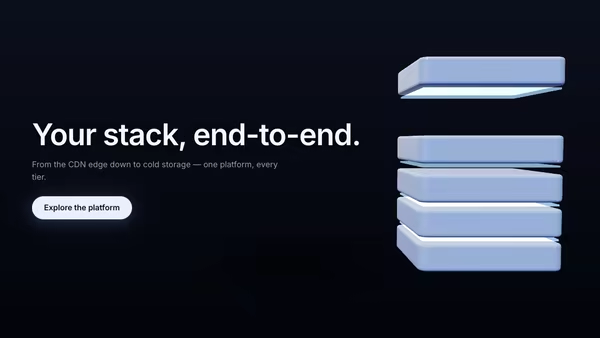
A 3D tower of translucent labelled slabs — CDN, Edge, API, Services, Database, Storage — that assemble tier-by-tier from the ground up, each slab settling with a soft physics-ish bounce. Thin glowing seams, real PhysicalMaterial transmission, PMREM HDRI lighting, pointer parallax. For high-end cloud / platform / infra-as-code landing pages.

API Network Map

A polished, three-dimensional graph of API services connected by glowing lines, with pulses of light traveling along each connection like requests in flight. Built for developer-tools, API-platforms, and infrastructure landing pages.

Floating Ceramic UI

A matte ceramic-like tablet panel with rounded edges presents your dashboard screenshot under soft studio lighting. The slab breathes through a slow yaw oscillation with subtle pointer-driven tilt; ambient occlusion sells the screen-to-bezel seam.

Floating Product

A 3D product model drifts and slowly turns in a quiet studio atmosphere. The model wears its own PBR textures; soft dust particles drift through the air around it.

Product Pedestal

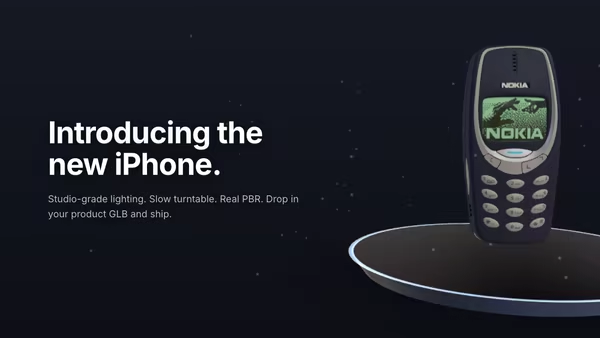
A 3D product model rests on a minimal floating pedestal under studio HDRI lighting. Slow turntable rotation, soft contact shadow, drifting dust, subtle mouse parallax, and press-and-drag to free-spin the product.

Product Turntable Studio

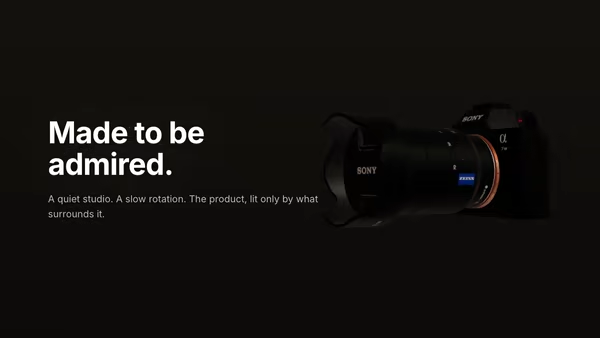
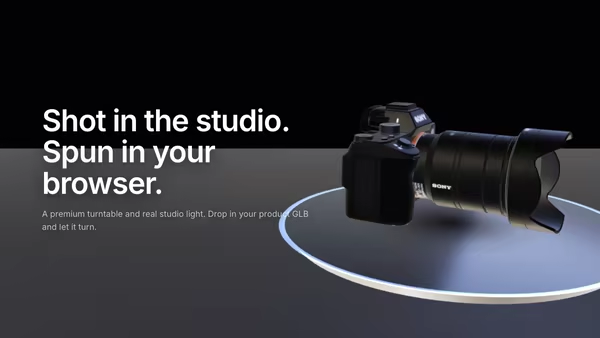
A 3D product model rotates on a premium polished turntable disc beside the hero copy. Studio HDRI lighting, warm key and cool fill softboxes, drag to free-spin, and pointer hover-zoom — a high-end product launch in code.
Live customizer

Database Core

Disk count4Number of stacked cylindrical disks. 5-7 reads as a classic DB icon; 10+ feels tower-like.Disk accentBody colour of the disks. Cool neutrals (slate, pewter) read most photographic.Seam glowColour of the emissive seam between disks and of the pulse rings.Glow intensity0.6How bright the seam glow reads. 0.6-1.2 is the sweet spot; above 1.8 starts to blow out.Core height1.45Overall vertical scale of the disk stack.Pulse rate0.7/sPulses per second. 0 disables; 0.5-1.2 looks like a steady production workload; 2+ reads as heavy traffic.Pulse strength1.3Brightness of the ring + seam flash.Pulse colorDefaults to the same hue as the seam glow; override if you want a query→response contrast.Satellite count6Small shapes orbiting the core — read as queries, indexes, replicas.Satellite colorEmissive tint of the orbiting shapes. White reads as 'incoming light'; coloured reads as 'labelled data type'.Orbit radius2.4How far satellites orbit from the core. Below 1.0 they clip the disks.Auto-rotate coreAuto-rotate speed0.26rad/sYaw rate of the core. 0.2-0.4 reads as ambient turning; above 0.8 starts to feel like a banner ad.Pointer parallax0.74How much the camera tilts in response to pointer movement.Transparent backgroundBackground colorRadial vignetteCentre colour of the radial vignette that softens the floor. Set equal to the background colour to disable.Heading fontInteractivityWhich input drives the hero — try Scroll if you want the page to drive motion.
CrazyGL · crazygl.comProgrammable hero sections for real websites.