CrazyGLCrazyGLHomeExploreGitHubBrowse heroesLoading hero…← Back to gallery@crazygl/liquid-data-core

Liquid Data Core

A glowing ray-marched glass sphere with refracted, dispersed inner orbits of data points — a living analytics engine that reacts to the cursor.

ReactWebGLInteractiveFont#raymarching#glass#refraction#dispersion#fresnel#analytics#data#premium#webgl

Usage

import LiquidDataCore from '@crazygl/hero-liquid-data-core';

export default function Page() {
  return (
    <LiquidDataCore
      heading="Your data, alive."
      tintColor="#6ab2ff"
      dispersion={0.45}
      ior={1.34}
    />
  );
}

Notable controls

  • Dispersion (0–1, sweet spot 0.4–0.6) — how far the prism splits color at the grazing rim. 0 is clean mono refraction; push past 0.7 for an obvious rainbow edge.
  • Index of Refraction (1.05–1.6) — how hard the glass bends the background. 1.34 reads as water-glass; 1.5 is dense crystal.
  • Realism (0–1, default 0.7) — master dial for micro surface detail, inner caustics, subsurface glow, and the grounding contact shadow. Drop toward 0 for a flat, graphic look.
  • Orbit Count & Points per Orbit (2–6 rings, 4–16 points) — density of the inner data field; fewer rings feel calm and editorial, more feel busy and alive. 4 × 10 is the photogenic default.
  • Pointer Distort & Pointer Orbit Drag (0–1) — how much the cursor dents the surface and how lazily the orbits trail it; around 0.4–0.5 feels responsive without being twitchy.
01 · Install the package

One command, zero config.

npm install @crazygl/hero-liquid-data-core
02 · Render the component

Import once, drop it in.

The component takes the same props you see in the live customizer on the right — every default ships poster-quality.

hero.tsx
import LiquidDataCore from '@crazygl/hero-liquid-data-core';

export default function Landing() {
  return (
    <LiquidDataCore />
  );
}
03 · Use it in a page

SSR-safe by default.

The wrapper renders static HTML on the server and only initialises the canvas after hydration, so search engines see your copy.

page.tsx
// app/page.tsx — works in SSR-first frameworks (Next, Remix, Astro, etc.)
'use client';

import LiquidDataCore from '@crazygl/hero-liquid-data-core';

export default function Page() {
  return (
    <section>
      <LiquidDataCore
        heading="Say hi."
        subheading="Your new hero."
      />
      <article>
        <h2>Welcome</h2>
        <p>Your content keeps its own voice below the hero.</p>
      </article>
    </section>
  );
}
You might also like

Similar heroes

Liquid Glass Badge Logo

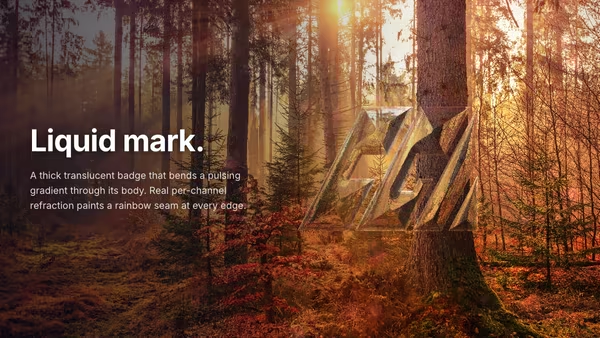
Your logo becomes a thick translucent liquid-glass badge that refracts a user-supplied photograph through its biconvex body. Per-channel IORs paint a real rainbow seam at the rim, the interior reads as frosted glass, and a 4-light Blinn-Phong studio rig sells the volume. Falls back to a rotating gradient backdrop when no image is supplied.

Liquid Metal Orb

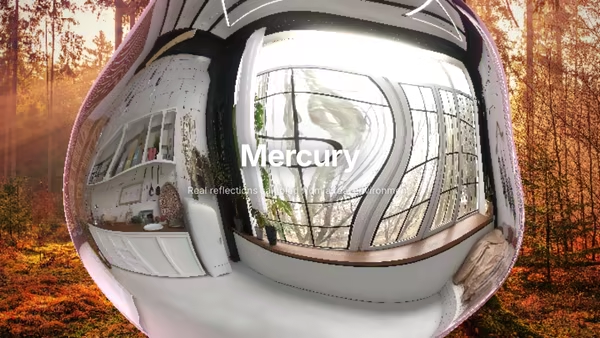
A floating mercury sphere ray-marched in real time, sampling a real environment image (or a procedural studio HDRI) for genuine mirror-like reflections. Drop in a photo to see it bend across the surface. Three layouts: orb centered or content beside it.

Glass Cube Maze

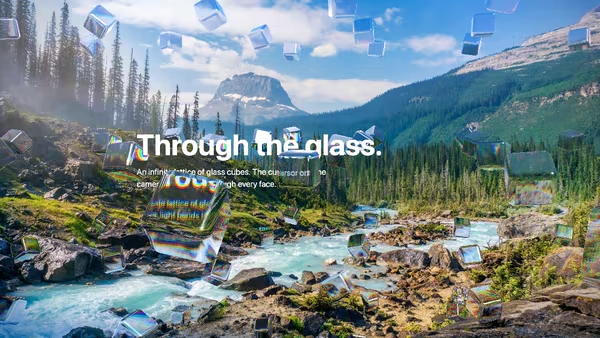
Raymarched lattice of transparent glass cubes drifting in 3D space. The cursor orbits the camera, and chromatic dispersion paints rainbow rims along the hits.

Glass Logo Sculpture

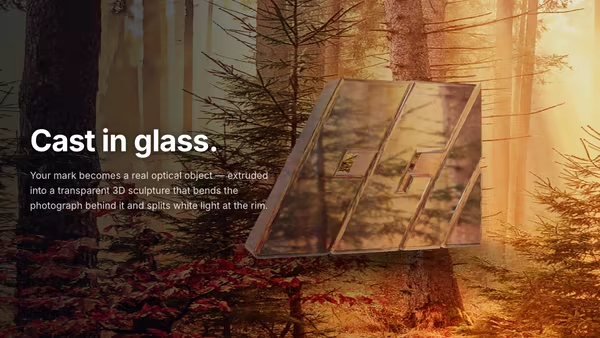
Upload a logo (SVG / PNG / GLB) and watch it become a real 3D glass paperweight: Three.js MeshPhysicalMaterial with true volumetric transmission, per-wavelength dispersion, clearcoat, Beer-Lambert attenuation, ContactShadows, an HDRI-lit studio rig and pointer-driven parallax orbit that visibly bends the photographic background through the body.

Logo Inside a Crystal

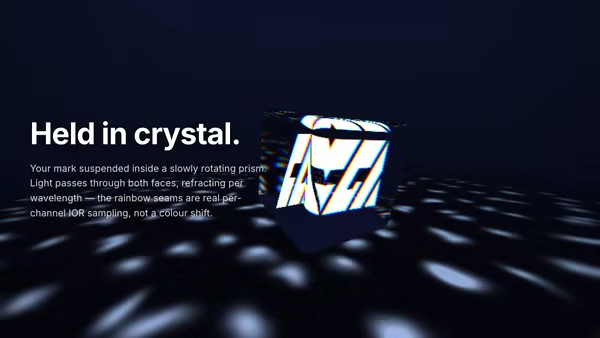
A slowly rotating crystal prism (3D ray-marched rounded cube) with your logo suspended inside as a glowing emissive mesh. Per-channel IOR refraction on the cube faces splits white light into rainbow seams; caustic highlights pool on the virtual floor; soft bloom on the inner emission.

Glass Panels

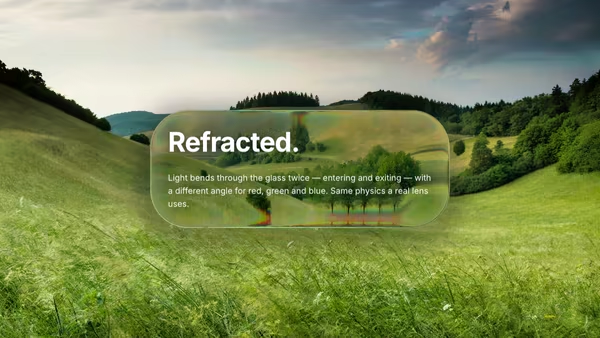
Liquid-glass panels in WebGL — half-sphere bevel, biconvex refraction (entry + exit + thickness), edge-weighted blur mix, multi-light Blinn-Phong specular, Fresnel rim, drop shadow. Drop in any background image and it gets bent through the glass.
Live customizer

Liquid Data Core

Sphere Center X0.32Horizontal position of the sphere within the hero. Negative = left, positive = right.Sphere Size0.5Sphere radius relative to canvas height.Glass TintBeer-Lambert tint inside the glass body.Dispersion0.45Per-channel IOR spread. 0 = mono refraction, 1 = obvious prism rim.Index of Refraction1.34Index of refraction. 1.34 = water-glass, 1.5 = standard glass.Orbit Count4Number of inclined ring planes inside the sphere.Points per Orbit10Data points per ring.Orbit Speed0.35HzOrbit Glow0.85Brightness of inner data points.Cool ColorWarm ColorAccent ColorHalo ColorHalo Strength0.45Background TopBackground BottomTransparent BackgroundDrop the backdrop so the sphere composites over whatever sits behind the hero.Realism0.7Master strength of the photographic-realism stack: surface micro-detail, secondary specular, inner caustics, SSS glow, density variation, edge dispersion, and contact shadow. 0 = flat/graphic, 1 = full realism.Subsurface GlowSoft ambient luminance from inside the volume (subsurface-scattering proxy).Pointer Distort0.5How much the cursor bulges the sphere surface.Pointer Orbit Drag0.4How much the inner orbits lag the cursor.Breath0.06Subtle sphere-radius breath cycle.InteractivityWhich input drives the hero — try Scroll if you want the page to drive motion.
CrazyGL · crazygl.comProgrammable hero sections for real websites.